
Shaping in Dog Training: Building Behaviour One Step at a Time
One of the most rewarding ways to teach a dog is through shaping. Rather than physically guiding a dog into position or luring them with food, shaping encourages the dog to think for themselves and actively work out how to earn reinforcement.
It can produce confident, enthusiastic learners and incredibly reliable behaviours, but like any training method, it has its strengths and its limitations. Understanding how and when to use shaping can make it a valuable tool in your training toolbox.
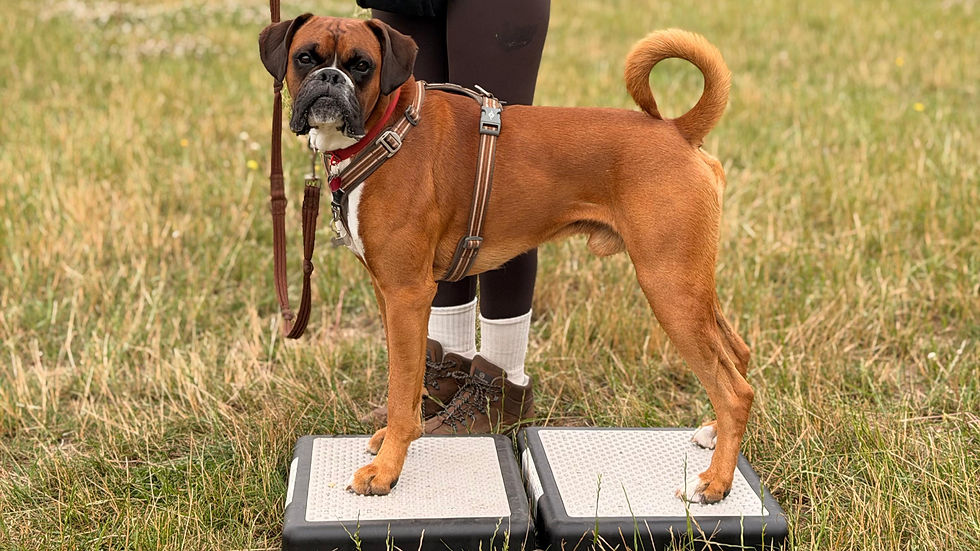
What is Shaping?
Shaping is a training technique where a desired behaviour is taught by reinforcing small, progressive approximations towards the final behaviour.
Instead of waiting for the finished behaviour to appear, the trainer rewards each tiny step in the right direction. As the dog becomes successful at one stage, the criteria are gradually raised until the complete behaviour is achieved.
For example, if you wanted to teach your dog to lie on a bed, you might reward:
Looking at the bed.
Turning towards the bed.
Taking a step towards it.
Touching it.
Placing one paw on it.
Standing fully on it.
Sitting on it.
Lying down on it.
Each stage builds upon the previous one until the dog understands exactly what earns reinforcement.
Shaping often uses a clicker or verbal marker (such as "Yes!") to precisely identify the moment the dog makes the correct choice.
Why Use Shaping?
Unlike some other training methods, shaping actively encourages the dog to become an engaged participant in the learning process.
Instead of following food or being physically positioned, the dog experiments with different behaviours and learns through trial and error which actions are successful.
This creates a dog that is often more engaged, more observant and more willing to problem-solve during training. Because the behaviour is the dog's own idea, shaped behaviours are often performed with greater confidence and enthusiasm.
Encourages independent thinking and problem-solving
Rather than waiting for constant guidance, the dog learns that offering behaviours can lead to rewards. This often creates a dog that enjoys learning and is willing to try new things.
Improves engagement
Many dogs become highly focused on the trainer because they are actively searching for opportunities to earn reinforcement.
Builds confidence
For nervous or uncertain dogs, carefully structured shaping can increase confidence by allowing them to discover success themselves without being physically manipulated.
Excellent for precision
Complex behaviours can be broken into tiny achievable pieces, making shaping particularly useful for sports, tricks, scent work and advanced obedience.
Encourages creativity
Dogs often begin offering new behaviours and solutions, making shaping particularly enjoyable for both trainer and dog.
The Downsides of Shaping
Despite its advantages, shaping is not always the right choice.
It can be frustrating
If you raise the criteria too quickly or fail to reward enough successful attempts, the dog may become confused and frustrated.
Some frustration is a normal part of learning, but excessive frustration can reduce motivation, increase stress or even cause the dog to disengage completely.
Timing must be excellent
Good shaping relies on accurate timing.
Marking the wrong behaviour - even by a second - can reinforce something unintended and slow progress.
Some dogs struggle initially
Dogs that have spent their lives being lured or constantly directed may initially find shaping difficult because they are not used to making their own choices.
These dogs often improve with practice, but the trainer must be patient.
It isn't always the quickest option
For simple behaviours, using a lure or environmental management may be considerably faster than shaping every individual step.

What Can We Shape?
Almost any voluntary behaviour can be shaped.
Some common examples include:
Place
Targeting an object
Touching a hand target
Retrieving objects
Opening or closing doors
Ringing a bell
Pushing buttons
Entering a crate
Scent detection indications
Hoopers distance skills
Trick training
Many behaviours used in assistance dogs, detection dogs and competitive sports are built almost entirely through shaping.
Understanding Frustration
Frustration often has a negative reputation in dog training, but the reality is more nuanced. Learning almost always involves a small amount of frustration.
When a dog encounters something they cannot yet solve, they experience a brief period of uncertainty before discovering the correct answer. This process is what helps learning take place.
The key is ensuring that frustration remains productive rather than overwhelming. A dog that pauses, thinks, experiments with different behaviours and eventually succeeds is likely experiencing an appropriate level of challenge.
In contrast, a dog that begins barking, grabbing at clothing, spinning, shutting down, repeatedly offering random behaviours or walking away is likely telling us that the task has become too difficult.
As trainers, our job is to keep the dog successful enough that they remain motivated whilst still being challenged enough to learn.
If frustration begins to build, the solution is rarely to continue pushing through. Instead, lower the criteria, increase the rate of reinforcement or return to an easier step before progressing again.
Think of shaping like climbing a staircase. If the steps are small, most dogs happily keep climbing. If one step suddenly becomes three feet high, they'll either stop climbing altogether or become increasingly frustrated trying to reach it.
Good shaping is simply about keeping the steps small enough that success comes frequently.
Final Thoughts
Shaping is one of the most effective ways to teach thoughtful, confident and engaged dogs. It allows dogs to become active participants in their own learning, encourages problem-solving and can produce incredibly reliable behaviours.
However, shaping is not a magic solution, nor is it appropriate for every dog or every behaviour. Like all training methods, its success depends on the handler's timing, planning and ability to recognise when the dog is becoming confused or frustrated.
Used well, shaping creates dogs that don't simply follow instructions - they learn how to learn. That ability often transfers into every aspect of training, making future behaviours easier to teach and strengthening the communication between dog and handler.


Comments